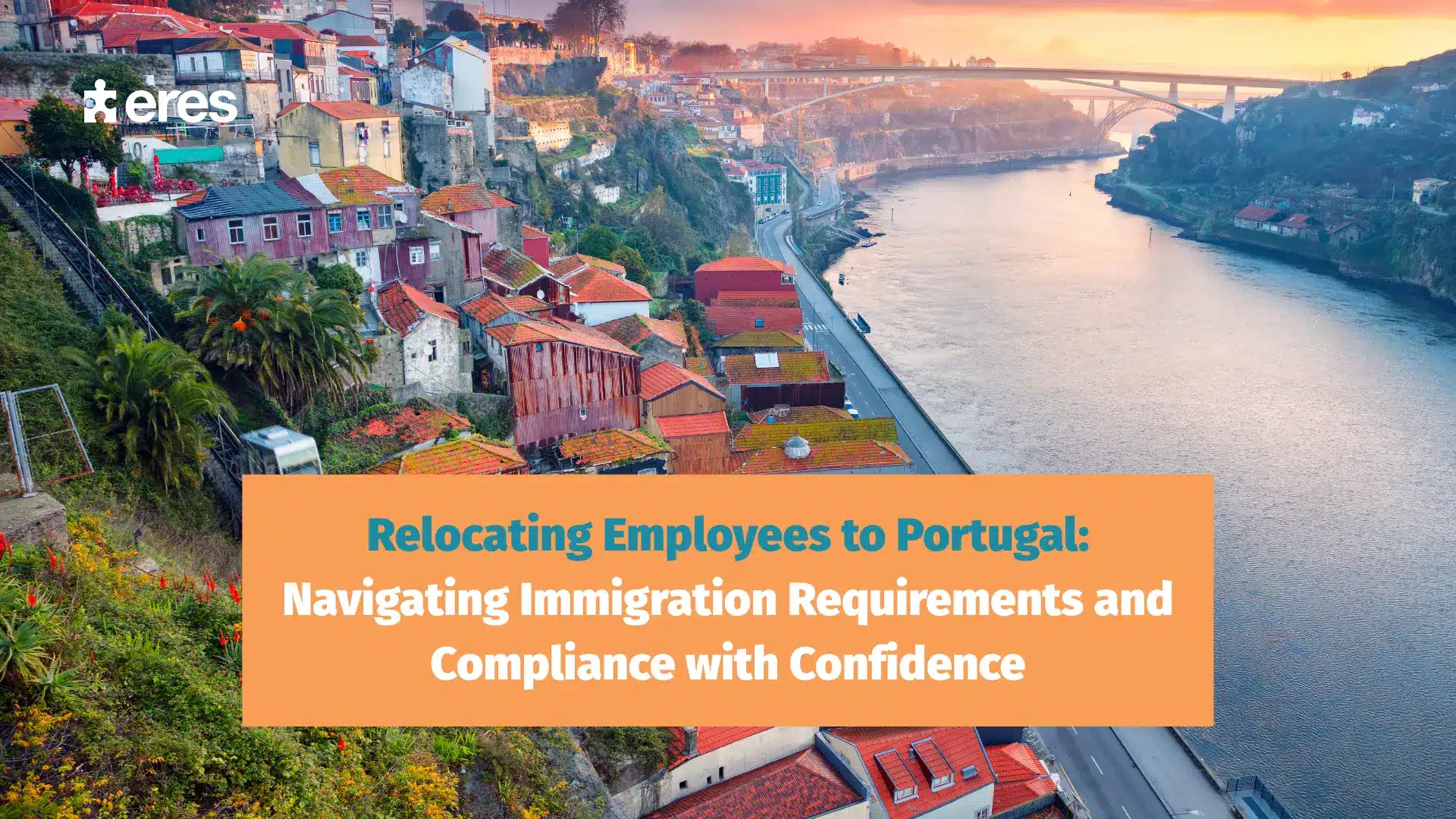
Portugal remains one of Europe’s most appealing destinations for international assignments, remote-first teams, and global hiring. But for employers, the practical side of getting a non-EU employee into the country has become more complex. Immigration rules have been reshaped, the main administrative agency has faced a well-documented backlog, and the gap between what a hiring manager expects and what the process actually delivers can be wide.
Relocating employees to Portugal with confidence doesn’t mean expecting the process to be fast. It means understanding the framework, choosing the right route early, planning realistic timelines, and keeping compliance in order from the first contract to the first renewal. This guide walks through what HR and mobility teams need to know.
1. Understand the Legal Landscape: What Changed with Law 61/2025
Portugal’s foreigners law was significantly amended in late 2025. According to a summary by the law firm MCS, Law No. 61/2025 took effect on 22 October 2025, with some measures depending on secondary regulations and with transitional rules for residence processes already underway. Based on that summary, the changes most relevant to employers include:
- Visas are valid only for Portuguese territory. Residence, temporary-stay, and job-seeking visas no longer give automatic access to other Schengen countries.
- The “manifestation of interest” route has ended. Residence applications must now start through a visa procedure at a Portuguese consulate before arrival.
- A new job-seeker visa allows highly qualified professionals to enter Portugal to look for work and start a job if hired before the visa expires. Those who do not find work must leave and wait one year before reapplying.
- Family reunification now requires adequate housing and stable income without reliance on social support, and authorities may require evidence of integration, such as Portuguese language skills.
These points come from a law firm summary rather than the legislative text, and some provisions depend on regulations still being issued. Employers should confirm the current position with AIMA guidance or a Portuguese immigration lawyer before planning a hire.
2. Choose the Right Route Early
There is no single “Portuguese work visa.” The right route depends on the role, the candidate’s qualifications, the salary, and the employer. The main options for employer-sponsored hires include:
Standard residence visa for subordinate work
This is the default route for most non-EU hires with a Portuguese employment contract. According to a vendor guide, most employers must register the vacancy with the national employment service (IEFP) before applying, to show that no suitable Portuguese or EU candidate is available — a test that can be waived for highly skilled positions or roles on the shortage occupations list.
Highly qualified routes (D3 and EU Blue Card)
For specialists, senior managers, and degree-qualified professionals, the highly qualified route and the EU Blue Card are usually the stronger options. Commentary indicates the salary floor is set as a multiple of Portugal’s average gross annual salary — around 1.5 times for most roles and about 1.2 times for certain shortage occupations. The exact euro figure differs between sources, so it must be verified against the current official threshold before an offer is made. Typical Blue Card conditions include a recognised qualification (or relevant professional experience), a clean criminal record, valid health insurance in Portugal, and a contract that states a salary at or above the threshold.
Tech Visa
The Tech Visa is aimed at employees of companies holding official tech-business certification, and approved companies can benefit from faster processing.
Intra-company transfers
For managers, specialists, and trainees moving to a genuine Portuguese branch or subsidiary, the intra-company transfer route can be an efficient option after a qualifying period with the group.
Job-seeker visa
The new job-seeker visa for highly qualified professionals can be a useful option for companies recruiting talent that is willing to relocate before a formal offer, though it carries the condition that a job must be secured before the visa expires.
Choosing the route before drafting the offer matters: salary level, contract terms, and even whether a labour market test applies can all change depending on the category.
3. Plan a Realistic Timeline — and Expect Friction
The typical sequence involves preparing the employment contract and employer documentation, the employee applying for the appropriate visa at a Portuguese consulate in their country of residence, and then — after arrival — completing the residence authorisation process with AIMA, Portugal’s immigration and asylum agency. One vendor guide suggests the residence authorisation itself can take around three to six months after biometrics and recommends planning for six months or more overall. The same guide notes that work can usually begin before the residence authorisation is issued if the visa is valid, though this should be confirmed for the specific route.
It is worth being candid about the operating environment. A July 2026 analysis from the International Bar Association describes ongoing friction around AIMA: progress on digitalisation has been uneven, appointment requests can still involve email, status visibility is limited, and coordination gaps between AIMA, social security, and the tax authority can slow down otherwise straightforward procedures. The analysis also notes that renewals remain sensitive — permits can expire before a renewal or appointment is completed, leaving applicants in an irregular administrative position despite having taken the required steps. Online renewal for residence permits (ARI) became available on 29 January 2026, which is a step forward, but the underlying risk of delay remains.
The practical takeaway for HR teams: communicate realistic timelines to the business and the candidate, and avoid fixing a start date around the best-case scenario.
4. Prepare Documents Early — But Not Indiscriminately
Good preparation reduces avoidable delays, but over-preparing can backfire. The same IBA analysis notes that some documents, such as criminal record certificates, have short validity periods, so gathering them too early can mean obtaining them again. A sensible approach is to map the document list for the chosen route first, then time the more perishable items close to the filing window.
- Confirm which documents require apostille, legalisation, or certified translation.
- Keep complete records of submissions, payment evidence, appointment confirmations, and all correspondence.
- Expect to follow up actively rather than waiting passively for updates.
5. Get the NISS and Employer Social Security Steps Right
Social security registration is a recurring friction point in Portuguese onboarding. Social Security has stated that companies may hire foreign workers even if they do not yet have a NISS (social security number), and AIMA’s position, as summarised by a Portuguese law firm, is that a valid employment contract is a mandatory requirement for obtaining the NISS. Once the NISS is assigned, the employer must report the employment relationship through the online Segurança Social Direta platform so that social security contributions are properly regularised.
The IBA analysis adds a useful practical note: employers do not need a NISS before signing the contract — the contract is what triggers its assignment — but in practice, payroll teams often delay onboarding until the number is issued. Aligning payroll and HR on this sequence in advance avoids unnecessary start-date slippage.
6. Plan for Family Reunification Conditions
Many relocating employees bring a partner or children, and the family’s immigration process needs to be planned alongside the employee’s own. Under the amended rules described above, family reunification requires adequate housing and a stable income, may involve proof of integration such as Portuguese language skills, and requires spouses and partners to be over 18 in a union legally recognised under Portuguese law. Employers can support families by flagging these requirements at the offer stage and by assisting with housing, since the housing condition is closely tied to the rental market. (For more on that, see Eres Relocation’s article on Portugal’s 2026 rental law reform.)
7. Manage Renewals and Permit Expiry Risk
Compliance does not end when the first permit is issued. Renewals need to be tracked as carefully as initial applications, particularly because of the delays described above. One vendor guide advises requesting renewal at least 30 days before expiry. Senior staff and executives who travel frequently are most affected by renewal delays, so mobility teams should maintain a renewal calendar and contingency plans for travel in case a permit lapses before the new one is issued.
8. Plan the Tax Angle Before the Offer Goes Out
Portugal’s tax regime for new residents has changed. The old Non-Habitual Resident (NHR) regime closed to new applicants at the end of 2023, and a narrower regime known as IFICI (sometimes called “NHR 2.0”) took effect in January 2024. According to a secondary guide, IFICI applies a flat 20% rate to qualifying Portuguese-source employment income for ten years, requires that the person was not a Portuguese tax resident in the previous five years, and is restricted to a narrower list of activities centred on research, innovation, and certain highly qualified roles. Eligibility is reviewed substantively by the Portuguese Tax Authority.
Because eligibility is narrower than under the old regime, employers should not assume that a relocating employee qualifies. Confirm eligibility with a qualified cross-border tax adviser before presenting a package that depends on it.
9. Build Compliance Habits, Not Just Checklists
- Assign a single owner for each relocation who tracks every deadline across immigration, payroll, and onboarding.
- Build immigration planning into recruitment from the start, rather than treating it as a post-offer task.
- Do not be deterred from hiring workers who are not yet in Portugal because of misconceptions about inspections or fines — instead, understand the process and document it carefully.
- Consider alternative sequencing, remote work where legally possible, or contingency plans when a start date is business-critical.
- Review each case periodically against current rules, since Portuguese immigration guidance has changed repeatedly in recent years.
Common Pitfalls to Avoid
- Assuming the pre-2025 rules still apply, including the “manifestation of interest” route.
- Fixing a start date around best-case processing times.
- Choosing a route before confirming salary thresholds and whether a labour market test applies.
- Gathering time-sensitive documents (such as criminal record certificates) too early.
- Delaying payroll onboarding unnecessarily because of the NISS, when the contract is the key document.
- Overlooking renewal deadlines and the risk of a permit expiring before the new one is issued.
- Promising tax benefits (such as IFICI) without confirming that the employee actually qualifies.
- Planning the employee’s move without planning for the family’s requirements.
How Eres Relocation Helps
Portugal rewards employers who plan carefully and communicate honestly about timelines. Eres Relocation supports HR and mobility teams through the whole journey: selecting the right immigration route, coordinating visa and residence permit steps, handling NISS and registration processes, supporting family applications, and providing on-the-ground settling-in help in Portugal — so employees and their families arrive prepared, and employers stay compliant from the first contract to the first renewal.
Relocating an employee to Portugal and want a clear, realistic plan? Contact us to build a compliant, well-timed relocation strategy for your team.
Disclaimer: This article is provided for general informational purposes only and does not constitute legal, tax, or immigration advice. Portuguese immigration rules, salary thresholds, processing times, and tax regimes change frequently, and some details cited here are drawn from secondary sources that may not reflect the most current official position. For guidance specific to your organization’s or employee’s situation, please consult a qualified immigration, tax, or relocation professional or contact us directly.