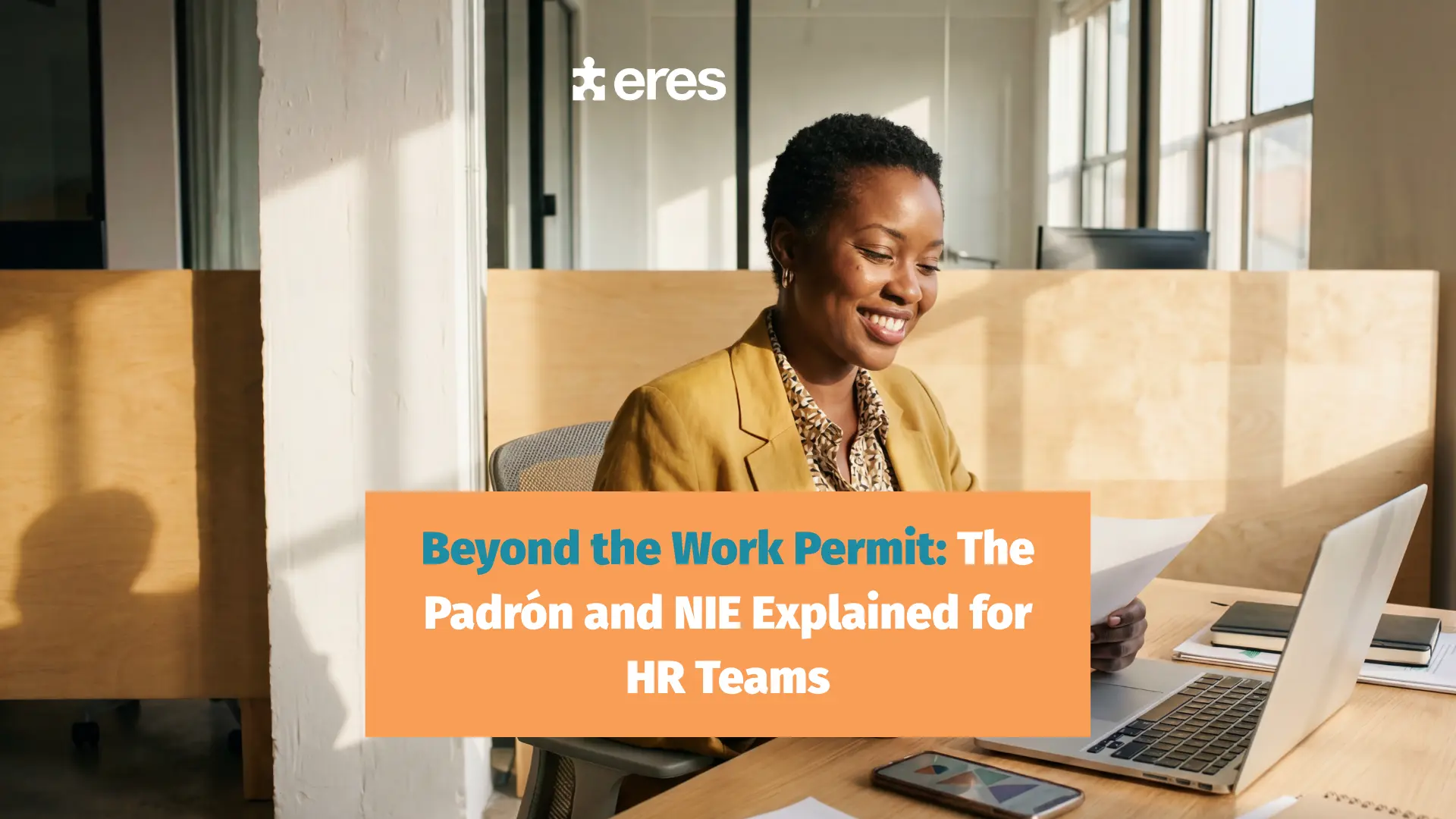
Securing the work permit often feels like the finish line when hiring from abroad. For HR teams, it is really the starting point. Two administrative pieces, the padrón and the NIE, quietly determine how smoothly a new international hire can start working, get paid and settle in with their family. Understanding them helps HR set realistic timelines, avoid onboarding delays and offer a better employee experience.
Why this matters for HR
International hires rarely arrive knowing how Spanish administration works. When the padrón or the NIE is missing, the impact lands directly on HR:
- payroll and Social Security registration can be delayed
- the employee may struggle to open a bank account to receive their salary
- finding housing, enrolling children in school and accessing healthcare take longer
- a stressful first month affects engagement, productivity and early retention
A well-informed HR team can anticipate these issues and build them into the relocation and onboarding plan.
The NIE: the number that unlocks employment
The Número de Identidad de Extranjero (NIE) is the identification number Spain assigns to foreign nationals. It is personal, lifelong and doubles as the employee’s tax identification number. It is issued by the National Police.
What it means for the employer
From an HR perspective, the NIE is the key that connects a new hire to the company’s systems. It is needed to:
- formalise the employment contract and add the employee to payroll
- register the employee with Spanish Social Security
- apply the correct tax withholding
- allow the employee to open a Spanish bank account and sign a lease
NIE and TIE: a common source of confusion
The NIE is a number. The TIE (Tarjeta de Identidad de Extranjero) is the physical residence card that non-EU employees receive once their work or residence authorisation is granted. It shows the NIE, together with photo and fingerprint, and is the document employees use to prove their legal status in Spain.
For non-EU hires relocating with a work permit, the NIE is normally assigned as part of the permit process, and the TIE is collected after arrival. EU nationals do not need a work permit or a TIE; they hold an EU registration certificate that also shows their NIE.
The regulatory context
Spain’s new Immigration Regulation, Royal Decree 1155/2024, now governs these procedures, replacing the previous regulation. For HR teams, the practical takeaway is that rules and documentation requirements have been updated, so internal processes and templates built on the old framework are worth reviewing. Appointment availability for police procedures still varies widely between cities, which should be reflected in onboarding timelines.
The padrón: the foundation of settling in
The padrón municipal is the local council’s register of residents. Being registered, or empadronado, means the employee is officially recorded as living at a specific address. It is free and should be done by everyone living in Spain, whatever their nationality.
Registration is independent from immigration status: it neither grants residence nor affects a pending permit. It is, however, the standard proof of address in Spain.
What it means for the employee experience
The padrón is less visible to the employer than the NIE, but it shapes how quickly an international hire and their family can build a normal life. It is commonly required to:
- access the public healthcare system and receive a health card
- enrol children in local schools
- exchange a foreign driving licence
- register a domestic partnership
- apply for certain residence cards and renewals
For employees relocating with family, this is often where the real friction appears.
Recent changes HR should be aware of
Large cities such as Barcelona have tightened their checks on proof of address to prevent registrations at fake addresses. This matters for international hires who start in temporary housing, short-term rentals or shared flats without a formal contract, as they may find it harder to register quickly.
Registration also needs to be kept current. Non-EU nationals without permanent residence must renew it every two years, or they are removed from the register. A change of address must be reported as well, something employees often overlook when they move from temporary to permanent housing.
Padrón vs NIE at a glance
NIE: identifies the employee for employment, tax and Social Security purposes. Issued by the National Police. Assigned once, for life.
Padrón: proves where the employee lives and unlocks local services for them and their family. Managed by the local council. Must be kept up to date.
The takeaway for HR teams
Attracting international talent is increasingly competitive, and the relocation experience is part of the employer brand. Companies that understand the padrón and the NIE, and plan around them, help new hires become productive faster, reduce early-stage stress and show from day one that they take global mobility seriously.
Hiring or relocating international talent to Spain? Our mobility team supports HR from the work permit to the employee’s first months in the country.
Disclaimer: This article is for general informational purposes only and does not constitute legal, immigration, tax, or relocation advice. Requirements, timelines, and costs vary by individual circumstances and change frequently. For guidance on your specific case, please contact the Eres Relocation team directly.