Relocation is often about change – new roles, new places, new experiences. But what if it could also drive positive change for the planet?
While regulatory momentum around climate goals fluctuates, the reality remains unchanged. Sustainability is still critical for businesses preparing for the future. Every decision counts, every emission matters. Yet one of the most overlooked areas for driving meaningful change lies within an unexpected space: the global mobility strategy.
Traditionally, global relocation is seen as a business function – a way to move talent, an operational necessity. But when we look closer, we see something more: a unique opportunity to influence not just where people live, but how they live. By embracing a holistic view on relocation, we can redefine its purpose, by creating a future where business growth and environmental sustainability are not mutually exclusive.
Rethinking Relocation
International assignments are much more than a change in geographical location – it’s a major life event, where nearly every aspect of daily life changes at once. From home and neighborhood, to language and culture, to people and workplace. This disruption, known in behavioral science as habit discontinuity, creates a rare chance to break old patterns and build new ones. Research by Professor of Social Psychology, Bas Verplanken, shows that during major life transitions, people are far more open to forming new habits, which makes relocation the ideal moment to introduce new sustainable ones.
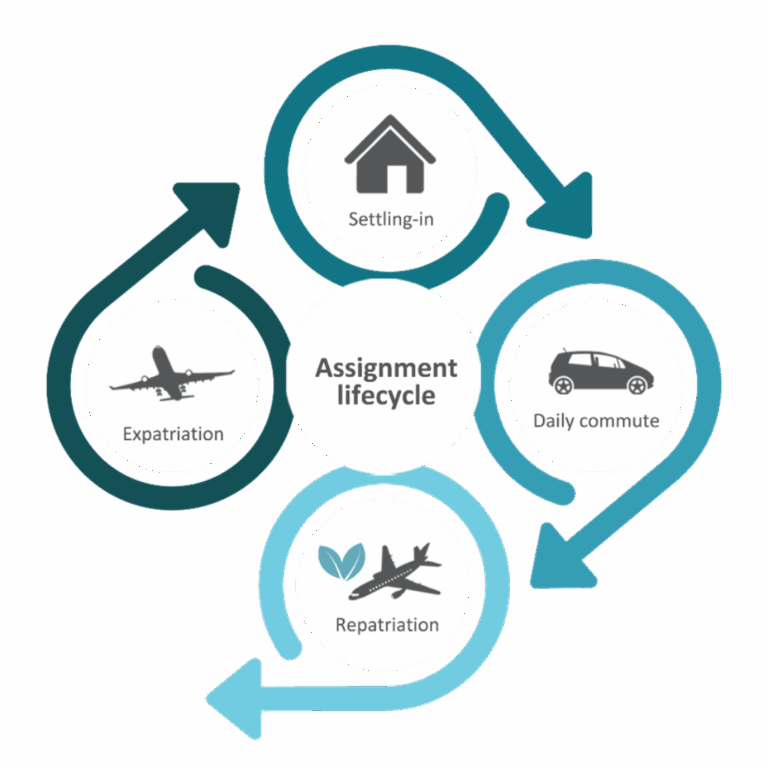
This is where the global mobility industry has a big potential. Too often, the focus is placed on the logistics of the move itself: the flights, the packaging, the transportation of goods. But the move itself is just the beginning of the assignment, it’s a whole cycle. Thinking of relocation in a holistic manner, creates the opportunity to change relocation into a force for sustainability.
Creating new, sustainable habits during an assignment might not seem like it could make a big difference. But it can. Think of it like switching from bottled water to a reusable bottle. One small change might seem insignificant at first – but over time, the impact adds up. Day by day, the choice becomes part of a routine that saves resources – and money – without extra effort. Relocation works the same way. A single move is just the starting point – but when it leads to lasting sustainable habits, the long-term impact can significantly reduce carbon emissions over time.
Relocation works the same way. The initial move may be carbon-intensive, but if it leads to lasting sustainable habits, such as eco-friendly commuting or energy-conscious living, the long-term impact can outweigh the short-term cost. With the right support, assignees are better equipped to make environmentally conscious choices from the start. At Eres Relocation, we see it as our responsibility to guide both organizations and their relocating employees toward more sustainable decisions, making every move a step toward a greener future.
Making sustainability a part of every step
Integrating sustainability into global mobility won’t happen by accident; it requires a well-structured and strategic approach. One of the first steps is to align mobility policies with ESG goals. These changes not only benefit the planet, but they also help companies better measure and manage Scope 3 emissions, which is often the hardest category to influence. Organizations that embed sustainability into every facet of an assignment can transition from mere compliance to being a sustainable industry leader.
Simply changing the policies won’t be enough; it is crucial to offer training to ensure that assignees understand the importance of making sustainable choices and recognize the impact they can have. By integrating sustainability into the relocation program, it becomes easier for assignees to adopt sustainable behaviors without needing to use extra effort.
But the real impact happens during the assignment. That’s why selecting a Relocation Management Company (RMC) that prioritizes sustainability at every stage is critical. At Eres Relocation, we carefully vet our suppliers and ensure that sustainable options are the standard, not the exception. Through initiatives such as providing curated local guides that promote sustainable services — from second-hand furniture shops and green banks to zero-waste stores and recycling points — and collaborating with like-minded partners such as ExpatRide to support low-emission commuting, we help you create meaningful change in global mobility. By ensuring continuous support and resources throughout the assignment, we empower employees to make environmentally responsible choices long after the move is complete.
Why lump-sum falls short
Lump-sum relocation policies – while popular for their simplicity and perceived flexibility – often undermine sustainability goals. By handing over full control to the relocating employee, organizations lose visibility and influence over key environmental decisions. Putting the whole burden on the assignee, battling an already stressful period, where they are facilitating a big move, they might prioritize convenience, often defaulting to less sustainable options. In contrast, structured policies guide and assist the assignee. Pre-vetted, eco-friendly options – like electric vehicle leases or sustainably furnished homes – ensure that environmental responsibility is the norm, not an afterthought. These structured approaches improve the employee experience, align with corporate values, and help track the environmental impact of global moves. It ensures environmental responsibility stays at the core of every move.
Moving forward with purpose
Global mobility has always been about helping companies grow, compete, and adapt in an increasingly interconnected world. But now, it also holds the key to helping businesses meet their environmental commitments. Approaching relocation strategically and holistically can create long-term sustainable practices. By breaking old habits and facilitating new ones – with the right support at every stage – organizations can turn each relocation into a driver for meaningful environmental progress.
By integrating sustainability into the relocation journey, organizations can create better experiences for their talent – while doing better for the planet.