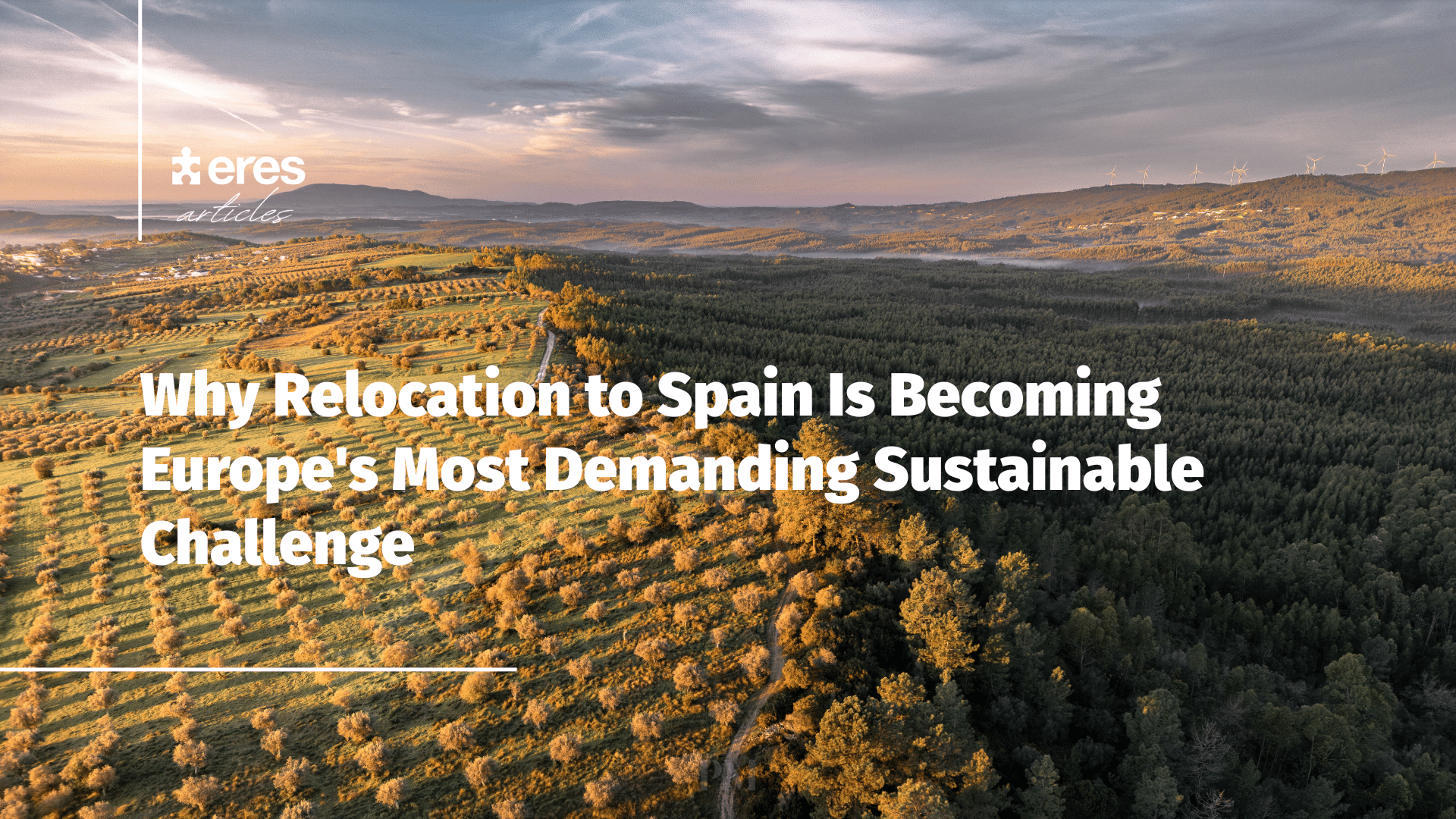
For HR teams and global mobility managers, relocation to Spain has moved from a straightforward process to one of the most demanding sustainable challenges in European mobility. Spain is one of the most requested relocation destinations in 2026, driven by quality of life, a reformed immigration framework, and strong demand from international professionals. It is also one of the countries where the gap between what sustainable relocation promises and what it requires in practice is widest. This article explores why Spain is raising the bar, and what HR teams need to prepare for.
This article is part of our Responsible Relocation in Europe series. Eres Relocation holds the EcoVadis Silver Medal 2026, top 15% globally in our sector.
Why relocation to Spain is rising up the HR sustainability agenda
Spain’s appeal as a relocation destination has grown substantially over the past three years. The Digital Nomad Visa, introduced in January 2023 under the Startup Act, has attracted a significant number of remote professionals from outside the EU. Demand from within Europe has also increased, with professionals from France, Germany and the UK relocating to Barcelona, Madrid, Valencia and Malaga in growing numbers. At the same time, companies with ESG commitments are paying closer attention to the sustainability credentials of their mobility programmes, including the destinations they send people to and the partners they use to manage those moves.
Spain’s combination of excellent public transport in major cities, an accessible rail network for domestic travel, a Mediterranean diet and outdoor lifestyle, and a strong renewable energy sector makes it a natural fit for sustainability-conscious organisations. The country generates over 50% of its electricity from renewable sources, has made significant investments in rail infrastructure, and has several cities consistently ranked among Europe’s most liveable and environmentally progressive.
The challenge is that Spain’s attractiveness creates its own pressures, and navigating those pressures in a way that is genuinely sustainable requires more preparation than most HR teams anticipate.
Sustainable relocation Spain: what the immigration framework now requires
Spain’s immigration landscape has evolved significantly in 2025 and 2026. The most notable change is the closure of the Golden Visa programme to new applications on 3 April 2025, under Organic Law 1/2025. For HR teams used to recommending this route for senior international hires, this is a significant shift. The Digital Nomad Visa and the EU Blue Card have become the primary routes for non-EU professionals, each with its own eligibility criteria and planning requirements.
The Digital Nomad Visa requires a minimum monthly income of 2,849 euros (as of 2026, tied to 200% of Spain’s national minimum wage). The Beckham Law, which offers a flat 24% income tax rate on earnings up to 600,000 euros per year, can be applied for within six months of registering with Spanish social security. The deadline is strict: missing it by even one day means losing access to the regime permanently. For senior hires where tax optimisation is part of the compensation conversation, this requires very careful coordination between HR, the employee and a specialist tax adviser from the moment the move is confirmed.
For EU nationals, the process is more straightforward, but still requires attention. Our team handles immigration and compliance across Spain and can advise on the most appropriate route for each profile.
The housing market: where sustainable relocation meets its biggest test
Spain’s housing market has tightened considerably. Property prices in Madrid rose by approximately 13 to 14% in 2025, following growth of 17.5% in 2024. Barcelona, Valencia and Malaga have seen similar dynamics. In 2026, Barcelona, Madrid and Malaga are designated as stressed markets under the 2023 Housing Law, meaning that rental price increases are capped by government indices in these areas. For landlords, this creates an incentive to reduce availability. For expats, it means a market that is simultaneously more regulated and more difficult to navigate.
From a sustainability perspective, the shift in the Spanish housing market towards newer builds is relevant. New construction in Spain in 2026 is required to meet significantly higher energy efficiency standards, and foreign investors and employers are increasingly prioritising assets with A or B energy ratings. For HR teams managing relocations to Spain, this means that housing choices with good energy credentials are available, but require more targeted searching and a longer lead time than in markets with more available stock.
Agency fees for tenants have been banned in Spain since 2025, a welcome development for incoming expats. However, the ban on agency fees has reduced the number of properties formally listed through agencies, as some landlords move to informal or alternative contract structures. Understanding the current landscape requires local expertise.
What sustainable relocation actually looks like on the ground in Spain
Beyond immigration and housing, sustainable relocation in Spain involves a set of practical choices that compound over the length of an assignment.
Spain’s rail network is genuinely world-class for long-distance travel. The AVE high-speed rail system connects Madrid to Barcelona in two and a half hours, Madrid to Seville in approximately two and a half hours, and to Valencia in less than two hours. For assignments involving regular travel between Spanish cities, or to France via the Barcelona corridor, a train-first travel policy is both a sustainability choice and a practical one. It is faster than flying once airport transit time is included, and it produces a fraction of the carbon emissions.
At Eres Relocation, our EcoVadis Silver Medal 2026, scored 72 out of 100 and placing us in the top 15% of companies globally in our sector, reflects commitments that extend to our provider network across Spain. Our Supplier Code of Conduct sets sustainability expectations for the local partners who manage removals, temporary housing and settling-in support. When you work with Eres Relocation in Spain, the sustainability standards apply throughout the supply chain, not just at the top of it.
What the best HR teams do differently when relocating to Spain
Organisations that manage sustainable relocations to Spain successfully tend to share a few consistent practices.
- They start immigration planning early, and they treat the Beckham Law as part of the assignment design, not an afterthought. For eligible profiles, the tax benefit is significant and the six-month deadline is unforgiving. The conversation needs to happen before the employee arrives, not after.
- They brief candidates honestly on the housing market. The stressed market designation in Barcelona and Madrid means regulated rents, but also reduced availability. Candidates who arrive understanding the market make better decisions faster.
- They build a train-first travel policy into the assignment from the start. Spain’s AVE network makes this practical for most major business routes. The carbon saving is real, and the time saving is often also real once airport transit is factored in.
- They choose a relocation partner whose ESG credentials can withstand scrutiny. For organisations that report on Scope 3 emissions or conduct supplier due diligence, the sustainability practices of a mobility partner are not a secondary consideration. They are part of the compliance picture.
Our team across Spain combines local expertise in Barcelona, Madrid, Malaga and anywhere else in Spain, with the group-wide sustainability standards that our EcoVadis certification reflects. Explore our relocation services or contact us to discuss your upcoming assignments to Spain.
Stay ahead of European mobility trends.
Subscribe to the Eres Relocation newsletter →
Planning a relocation to Spain?